

Picture it: you open Tinder and you see somebody bearing the particular facial features, hair, body and confidence that you fancy. In other words, the particular traits our culture has taught us to desire.
You swipe right, and almost immediately begin preparing yourself that you two will not match. Before they have rejected or accepted you, the hierarchy has already been established.
They are the person who gets to choose. You are the one waiting for confirmation whether you are worthy of a match or destined to disappear into the void with everyone else they have swiped left on.
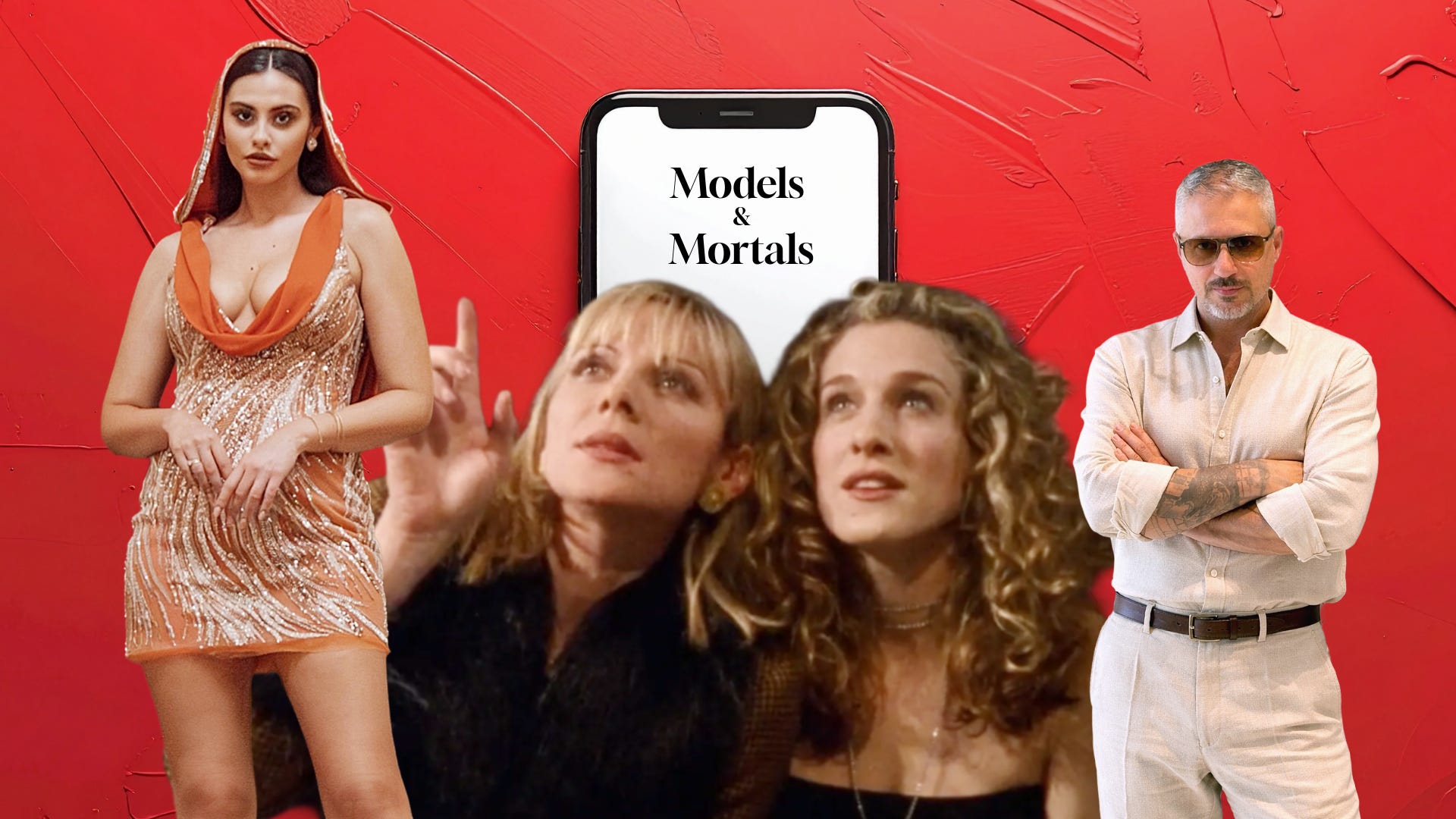
This exact hierarchy was labeled as “Models and Mortals” in the second episode of the pilot season of Sex and the City.
The episode introduces the modelizer: a breed of man obsessed with women, much like the womanizer, but with the core distinction that the modelizer is obsessed not with any women, but with models.
To a modelizer, being chosen by a model becomes evidence that he must possess extraordinary qualities other men do not, because the title “model” is a symbol of access, achievement, status, and beauty—qualities that models presumably would not spend on just anybody.
Almost thirty years after that episode aired, in 2026, there are still modelizers, and maybe they are even more numerous, because if in 1998, they needed access to New York fashion parties and the women whose faces and bodies appeared in magazines, then nowadays, the modelizers need only a smartphone.
We are all models now
Professional models still occupy a glorified position in our culture, their faces still sell advertisements, and their bodies are still treated as properties of their agents and the public, at least partly.
But the distinction between models and mortals today has become significantly less stable as social media has made almost everyone pose for a version of themselves:
The pretty one.
The young one.
The cute one.
The smart one.
The ambitious one.
We choose how to present ourselves online through photos and different angles, posing at glamorous or recognizable locations, and we all feel the need to display our work, family life, and relationships as something that requires public validation.
Technically, we are all modelling ourselves.
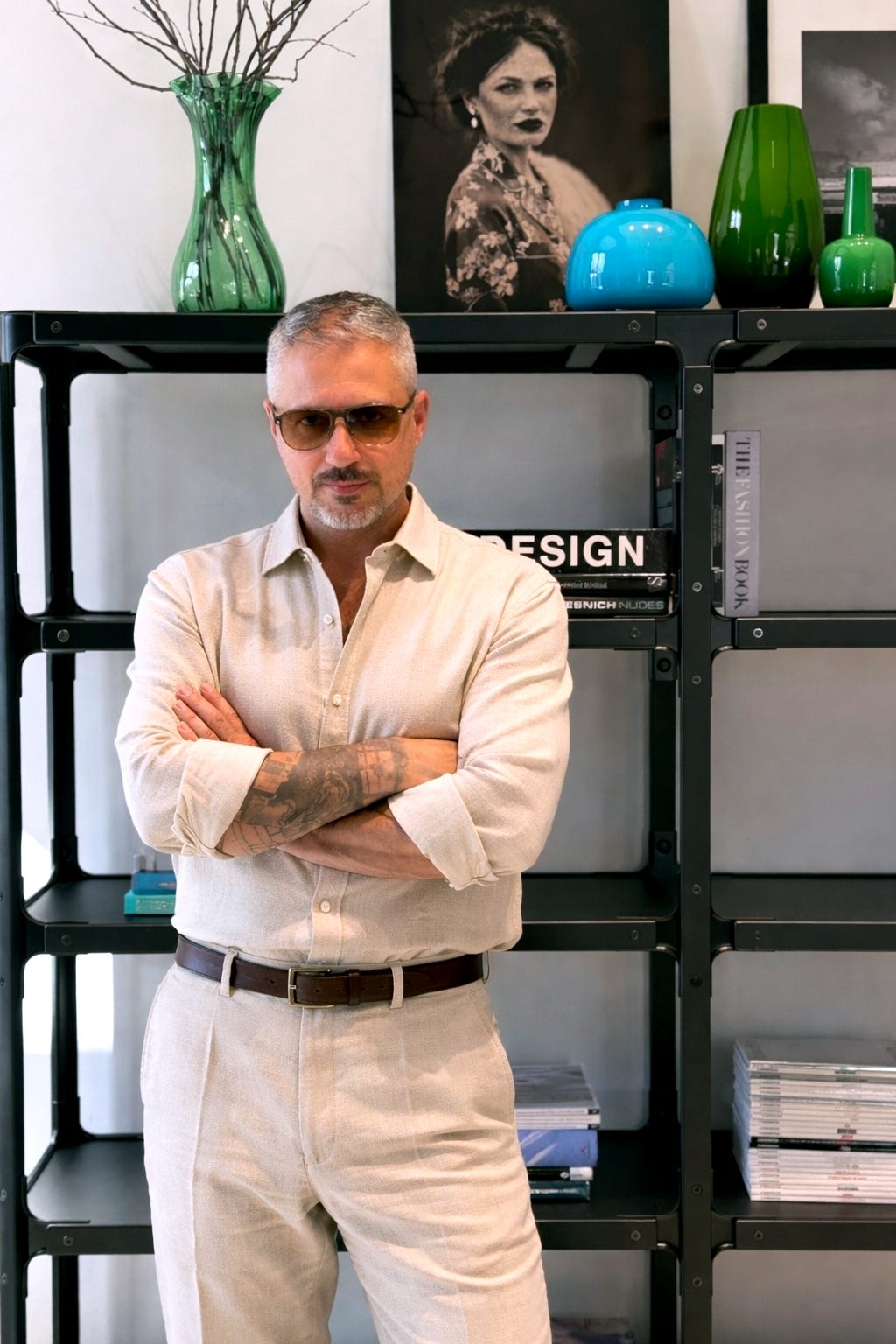
Bulgarian designer and artist Stoyan Dimitrov describes social media as the modern equivalent of a corset, as he mentions in our interview, without even realising how accurate he has just described our new current.
“Social media determines how people see us,” he explains. “We build the structure of the corset there and shape the figure through which we want to present ourselves.”
According to him, that figure shall not be understood only as the body, because today, our partners are another part of the silhouette, too.
The partner is evidence
When we introduce our partner to other people, we rarely present only that person.
We also present the version of ourselves that exists beside our chosen ones, so they have to meet some criteria of course.
We want them to look good, to have beautiful hair, an attractive face, a well-maintained body, appealing style, and some other quality suggesting that this person could have chosen anybody.
And yet, they have chosen us.
Their desirability becomes evidence of ours.
If somebody beautiful has chosen us, perhaps we must be beautiful enough. If somebody interesting has stayed beside us, perhaps we must be interesting too. If the person appearing beside us in our photographs seems impressive, then perhaps their presence confirms the version of ourselves we want other people to see.
None of this means that attraction to beauty is shallow, not that every picture of a happy couple is a performance. Beauty is real, so is desire, and so is the pleasure of looking at somebody we love and believing they are extraordinary.
But the pursuit of perfection can become increasingly insatiable.
Stoyan describes it as an appetite that expands as soon as it is fed.
“When you take a bite and become satisfied,” he says, “you start looking for the next one—bigger, with more flavour and colour.”
So the partner becomes an upgrade.
One person completes and adds the final touches to the desired version of ourselves, and the potential future partner seems capable of completing an even more impressive version.
This may resemble reinvention, but when an identity is primarily built from the outside, the reinvention can never quite be complete.
The violence of feeling insufficient
In “Models and Mortals,” Miranda painfully discovers that intelligence, career success and ordinary attractiveness cannot compete with somebody chasing the status of a “model”, so in the modelizer’s eyes, Miranda is a mortal.
Today, this is still valid.
People who are not conventionally attractive may possess intelligence, sensitivity, humour, artistic ability and fascinating ways of understanding the world, yet never receive enough initial attention for those qualities to become visible.
Choosing a partner today, especially through dating apps, while we are still seeking the perfect match, could feel like being trapped in a cage built from first impressions.
For much of my life, I have been put in boxes, too—cute, sweet, sensitive, geek—and I am not saying that those words are cruel, they are true.
But they are incomplete.
Being perceived as “cute” does not mean I am not ambitious, nor does it erase my sexuality. Being described as sensitive can sometimes make my complexity sound fragile, even though I know it is not.
I cannot count the number of times I have wanted to say:
Yes, I am sweet. I am also smart, intelligent, difficult, artistic, hot, ambitious, and capable of holding a conversation that extends beyond the limits of:
“Do you have a place?”
Yet it seems our appearances arrive before we do, and they make it easy for people to sort our personalities into categories they find convenient to comprehend.
Within gay dating culture, what is generally considered desirable is the muscular body, the carefully maintained beard, and a specific performance of masculinity.
And there is me—a twink, bearing a moustache—looking at the kind of “gorgeous” man I described and assuming, before I have even swiped, that he would never choose me.
And just like that, I appoint myself the mortal.
The person on the cover
If the mortal fears that nobody will look, the model fears nobody will look beyond the label.
During her decade-long career, Vogue Ukraine cover star, Bulgarian supermodel Ivelina Choeva-Kadieva has learnt that the features one culture interprets as flaws may be precisely what another considers remarkable.


In certain pictures, she has noticed that she might appear slightly cross-eyed. In Bulgaria, she has encountered comments mocking that difference, but internationally, it became part of what made her face interesting enough to hire.
“They have given me work and paid me precisely because of that imperfection,” she told me in our conversation, “because somebody, somewhere, found it beautiful.”
That immediately complicates the idea of perfection, because beauty is not necessarily defined by correcting every slight asymmetry until a person resembles a culturally approved image. Sometimes beauty is defined exactly in the asymmetry, the small flaws, or the feature that prevents a face from becoming interchangeable.
But being recognised as beautiful creates another problem.
Choeva does not pretend beauty has never helped her. A striking or well-maintained person naturally receives attention, she says, and physical appearance can make certain doors easier to open.
Yet after completing her education in London and entering another professional field, she discovered that the same image that once granted access could also prevent people from taking her seriously.
She had been understood as a model, as beautiful, as a woman with long legs. When her work demanded another kind of competence, she had to convince people that the person behind the appearance could actually perform it.
“Almost all of these women have other qualities and interests beyond what is shown,” she says of models and influencers, remembering colleagues who studied medicine or spoke six languages while travelling and working.
Beauty can elevate and diminish a person simultaneously.
It attracts the gaze, but can narrow the terms under which someone is understood, and it turns out the image arrives before the human being and threatens to become the final verdict.
Even nakedness can become a costume
The episode’s darkest expression of the modelizer appears through Barkley, who secretly records his sexual encounters with models.
First of all, this act today would be scrutinised even more severely: the recordings are non-consensual and explicit, intimacy turns into a collection of trophies, and the women themselves become evidence of his worthiness.
Consensually sending an intimate image on a social media app is fundamentally different from recording somebody without their consent, but both exist within a visual culture in which even nakedness can become part of the performance of worth.
We send images hoping to prove that our bodies possess the correct forms, proportions or sexual characteristics. We present ourselves at our most physically exposed to strangers for rapid assessment and turn nudity into a costume when it is performed primarily to secure approval.
Being chosen does not cure the fear
I have dated men I considered extraordinarily attractive in entirely different ways.
One looked like a fashionable Apollo and was emotionally unavailable. Another was intellectually impressive as well as physically attractive and very pretty. Another had long hair, tattoos and a body unlike anybody I had dated before.
Before each of them chose me, I doubted that they ever could.
And even after they did, being chosen did not permanently remove the doubt.
This may be the modelizer’s most humiliating secret—you may have a beautiful partner beside you and still believe you are the mortal who somehow was granted access by mistake.
And today, we have become both model and modelizer
That realization made me stop.
For most of this piece, I had been wondering whether I had been the model or the mortal to the men I dated.
But I had not realized I had also been a modelizer. I was being evaluated, but I was evaluating, too.
The men I dated were all gorgeous, therefore, they were worthy of being chosen, and I was always very proud of walking beside them through the streets of Istanbul. I also particularly remember the pleasure of entering somewhere together noticing people turn their heads:
“We are getting noticed,” I would think and I would even hold my partner’s hand even tighter.
And there it is—I chose. My partners chose. I desired them partly because I found them desirable and their desirability sometimes made being chosen by them feel even more significant.
We swipe through people while knowing other people are swiping through us.
We curate ourselves on Instagram and dating apps, and we select photos, manufacture first impressions. So we are models.
We assess other people’s faces, careers, lifestyles, and status. So we are modelizers.
And everyone else is doing precisely the same thing to us. So everyone is both a model and a modelizer.
And suddenly, Sex and the City Season 1, Episode 2 begins to resemble an early version of a culture that swallowed almost all of us.
What happened privately between me and my former partners is now built into contemporary dating—everybody presents, everybody evaluates, and everybody wants to be chosen by somebody they themselves consider worth choosing.
Which translates into:
We’re all modelizers because we are casting.
We’re all models because we are auditioning.
When the corset comes off
Stoyan Dimitrov’s metaphor reaches its most revealing point when he imagines the moment after the corset has been removed.
Underneath it, the person is naked—the structure that shaped the body into a silhouette is no longer there.
“If the people in front of whom you have undressed accept you as you are,” he says, “then you never needed that corset.”
This may be the real challenge of connection in 2026.
Not whether we can attract somebody through the image, but whether we can survive being known after the image is gone.
Not whether somebody will display us proudly, but whether they can understand the qualities that cannot be photographed.
Not whether we can reinvent ourselves through the person beside us, but whether we know who we are when we stand alone.
The answer is not to deny beauty, attraction often begins with appearance.
The answer is to allow the gaze to become curiosity, and curiosity to become knowledge—something capable of complicating the first impression rather than merely confirming it.
Maybe the most radical reinvention is not becoming somebody the world would proudly display, nor becoming someone who always evaluates, nor continuing to live simultaneously as model and modelizer.
Maybe reinvention is becoming somebody who no longer needs another person’s beauty to prove that I deserve to be seen.