

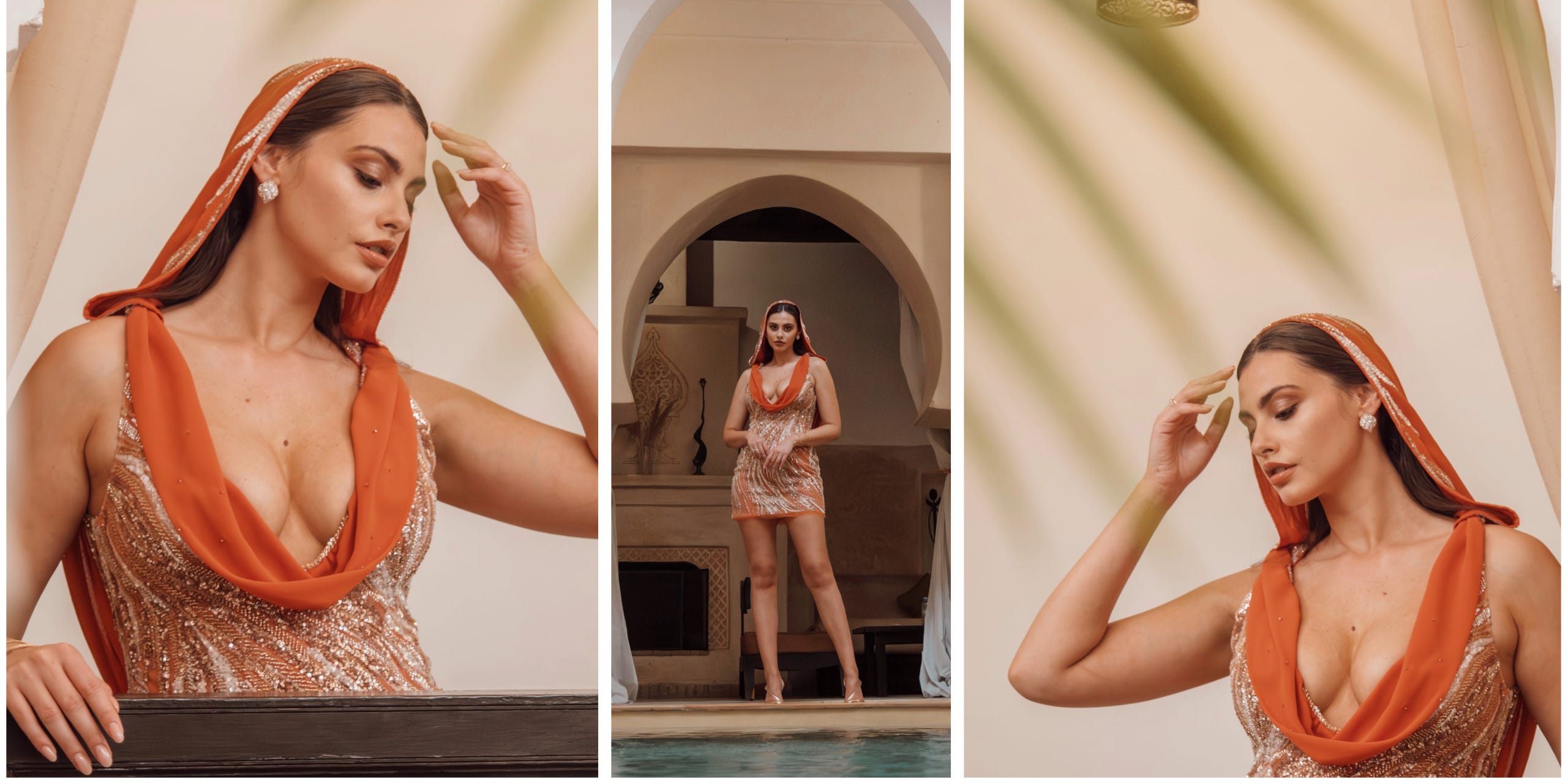
I find Ivelina Choeva-Kadieva, Bulgaria’s diamond in the modelling industry, at the very beginning of the summer, relaxing in the quiet of her home. She is avoiding the sun and the heat, not because she insists on keeping her skin snowy white, but because she is carrying a new life in her body.
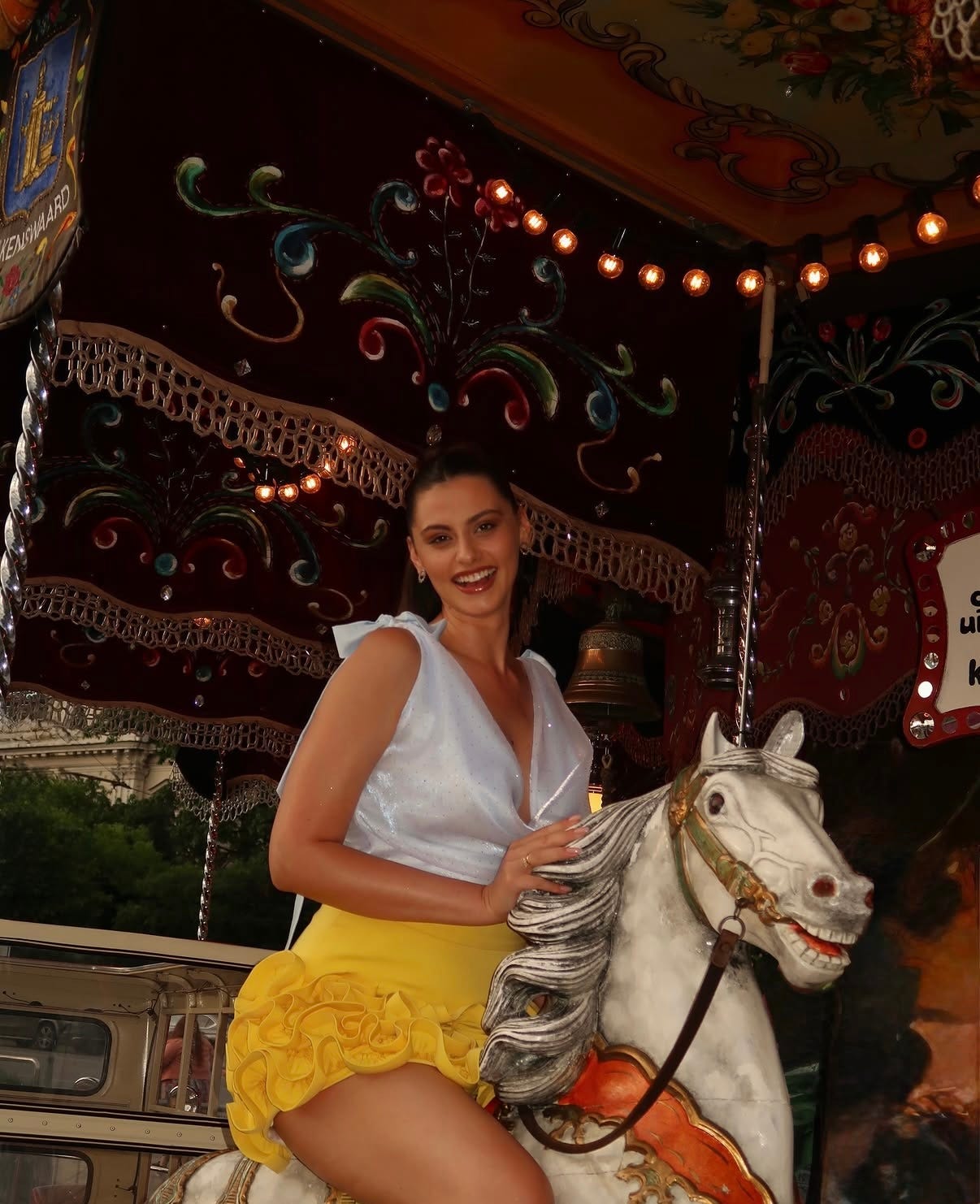
Ivelina calls this stage of her life an amusement park with a visible spark in her eyes — carousels, little cars, we bump into each other, we fall, we get up.
That is a strange thing to hear from a woman who has spent most of her life being measured.
At thirteen, she left Haskovo for Milan on a pink airplane, carrying a pink Bulgarian-English phrasebook in her bag, “in case something happened,” she says. Nothing in her childhood had initially pointed toward runways and spotlights. She had a strict mother, and Ivelina was following the blueprint of the perfect student, her grades had to stay perfect, too, and she was even attending mathematics competitions.
Everything, she tells me, went inside her notebook. “This is my current notebook; I have many others.” She is organized, neat, and tidy, and it is actually not surprising. Her entire self was built on precision, considering that a model’s body is watched and documented. It is part of a model’s grammar.
Ninety centimeters here, not ninety-two. A girl that is 1.85 meters tall and a girl of 1.75 meters height are held to the same number anyway, because the industry rarely bothers to ask whether its arithmetic is fair.
So how does a woman built on precision arrive a little more than a decade later at a life, resembling an amusement park?
That is where this conversation actually starts.
She tells me that the years before her pregnancy were not calm. She and her husband, actor and TV presenter Aleksandar Kadiev, were — in her words — “in a hundred places at once.” Somewhere underneath the busyness of it all, they were beginning to try for a baby, and there was the belief, as she jokingly says, that this too could have gone into the notebook, checked off like everything else.
“I had always imagined it would happen quickly,” she says. “Or that it would just happen, without planning it so much.”
When it did not, the stress began to take up more and more space. The pressure became internal, too, outside the chaos of day-to-day life. Every morning, she found herself thinking about the same thing.
People around her kept offering the least helpful piece of advice anyone would like to hear while they are inside the experience: calm down.
“At some point, I got tired of worrying,” she says. “I said to myself: Fine. If it doesn’t happen, it doesn’t happen. I couldn’t do it anymore. I was exhausted.”
And yet, with time, she arrived at the lesson everyone had been trying to give her, not by waking up feeling enlightened on a nice morning, but because she had no other choice.
“I see it as a lesson from fate and as a life lesson — that I cannot control everything,” she says. “And the moment I somehow let go of control, it happened.”
I ask her why she thinks people still refer to pregnancy as something beautiful and natural, but rarely talk about the struggles some women go through. She tells me that everybody around her talks openly about that and she is in a no-filter circle, that was always supporting her, but there was a loneliness underneath it all that no amount of support could fully reach.
“No matter how much you share with someone — even with my husband, who is in this with me — you start to feel lonely,” she says. “Because, after all, you are waiting for something to happen inside you.”
Support, then, becomes essential not because it removes the loneliness completely, but because it makes the loneliness survivable.
“Support is very, very important,” she dives deeper. “The most important thing is to calm down, yes, but you cannot calm down if you don’t have the kind of support that makes you feel safe.”
Pregnancy, for Choeva, has not erased the old vocabulary of modeling, but is teaching her to replace it.
“I’m not going to lie to you,” she says. “I have 10 to 12 years of experience as a professional model, and I think that has a huge influence. I’m used to looking a certain way.”
Now her body is changing. She knows this is normal. Still, there are moments, “I get out of the shower, I see this, I see that,” she says, half-laughing at herself.
Her eye is trained, and her questions are actually not irrational, because inside them lives the history of an industry.
“Have I gained too much weight? Is this new here?”
Her husband, she says, laughs at the questions, too, because his eyes have not changed, even if her body has started to. “In his eyes I see that he still likes me very much and loves me very much. That gives me security and calm.”
She is learning to meet the change with admiration instead of measurements — to stop translating her body into the vocabulary that she has absorbed, because old grammar disappears slowly.
But Choeva does not dramatize the old grammar - she does not perform suffering for the sake of story, nor does she pretend that modeling is a uniquely tragic profession. She is just honest about the industry and its requirements. It is a job, and if you would like to do it, then you have to meet the requirements.
“To work as a model, you have to be within certain measurements,” she says. “My body is the kind that, if I eat, I gain weight — I’m not one of those stick-thin girls.”
In her teenage years, when the body naturally begins to change and form, those changes collided with professional expectations. There were several years, she says, when she did “terrible things” with diets and not eating. She sees it now as a mistake.
“The industry doesn’t care very much about how you feel,” she says. “What matters is being within the measurements.”
Still, guided by resilience, her story is one of curiosity, independence, discipline, friendship, and taste.
After she received the offer for a contract in Milan when she was 13, she saw that as a great way to make her life more interesting.
“I was like: There it is. The gods, the stars, this is it,” she says. “I couldn’t believe it.”
More contracts followed — Asia, Europe, the United States — while she continued her education independently and returned to Haskovo once a year to pass her exams, still having to keep up to the image of the perfect student.
“I had no real idea what the world was like,” she says of that first Milan trip. “I was simply endlessly interested. I was like a sponge. I wanted to touch everything, talk to everyone, hear every story, learn everything.”
There was glamour, of course, but not always in the way people imagine.
“Glamour is what you see in magazines,” she says. The rest could be crowded apartments, tiny rooms, strange cities, shared space, early call times, and constant motion. In Tokyo, she remembers rooms so small that “you take one or two steps and that’s the width,” with three girls inside.
But none of it bothered her much. She wanted something to happen. She wanted life to open.
“For me, it wasn’t important where I slept or what I ate,” she says. “I wanted something to be happening around me.”
The industry gave her independence. Discipline. A sense of beauty. A feeling for style and behavior. It also gave her an early education in the relativity of beauty — perhaps one of the most interesting parts of her story.
When she started modeling, Bulgaria was beginning to embrace artificial glamour - thin eyebrows, crimped hair, Botox, silicone. But the modeling environment around her valued something completely different - clean skin, clean hair, no makeup, naturalness, imperfections, irregularity.
“Girls with more irregular features were considered more interesting because they were more unconventional,” she says.
This is where the Bulgarian gaze and the fashion gaze began to separate.
Choeva mentions that her eyes can appear asymmetrical in some shots, as if she is slightly cross-eyed. In Bulgaria, as she became more recognizable, online comments mocked her for it.
“Who is that cross-eyed girl? What Vogue? Super ugly.”
What others treated as a flaw, the fashion world had treated as an asset.
The industry that measured her hips to the centimeter, was the same industry that hired her eventually for a Vogue Ukraine cover — because of the one thing her own country called a flaw.
“I have been hired and paid precisely because of that imperfection,” she says, “because someone somewhere found it beautiful. You can’t insult me by saying that.”
By the end of our conversation, beauty has become our main topic, larger than image. Choeva speaks about wanting her son to have a sense of beauty — not only female beauty, but the beauty of the world.
“Beauty is not a science,” she says.
Which may be why, when I ask how she would describe this exact stage of her life — no longer counting, no longer measuring against anyone else’s number — she does not reach for a statistic at all.
“An amusement park,” she says.
There are carousels, little cars, collisions, falls, getting back up. Colors everywhere. Something is always sparkling, something is always happening. It is busy, she says, but “mega cool.” She feels like a child in an amusement park.
It is a lovely answer, but also revealing.
After years in an industry where the body could be reduced to centimeters, Ivelina now describes her life not through the perfect lines or fixed measurements, but through movement and color, which is not a number someone else can approve.
Perhaps this is the new grammar she is learning now - a body changing, a child coming, a woman extending her knowledge of her own beauty.
Not the grammar of centimeters.
The grammar of wonder.