

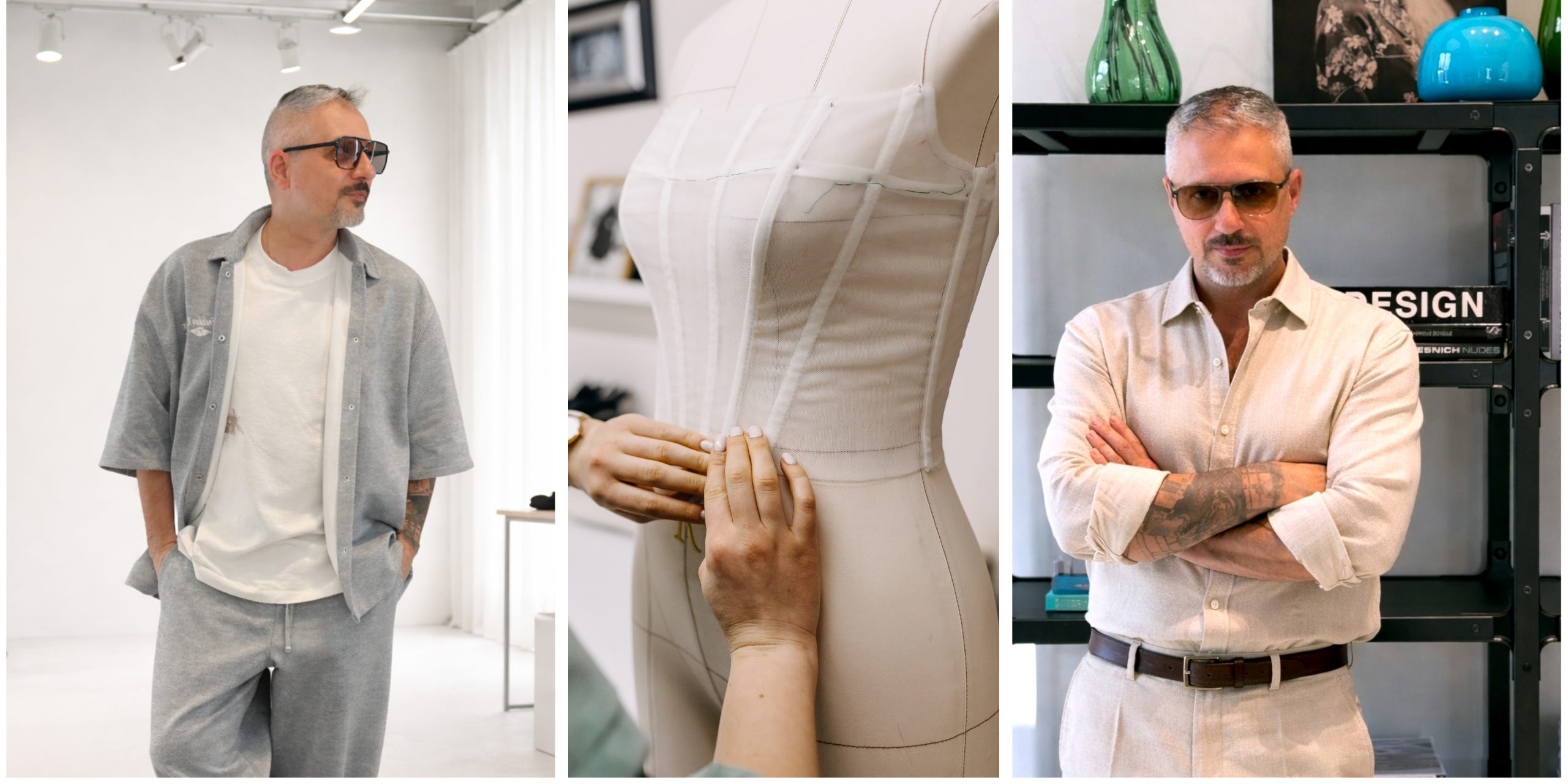
As we are catching up on the latest events in our lives and talking about some trends we have seen recently, Bulgarian designer Stoyan Dimitrov begins what will become our interview with an undressing before I have even asked a single question.
“When you take off the corset, you are left naked,” he says, as if it were the most common way to start a conversation about anything, whether it is a garment, a body, or a life. He tells me that social media is the corset now. We shape ourselves inside it, we allow it to hold us in the form we would like to be seen in, and underneath it we are exactly as naked as we always were.
It is a strange thing to hear from a man who has spent twenty-five years building structure into fabric for a living.
As a child of the 1970s, Stoyan found himself in a Bulgarian classroom in a subject called Practical Training, and while the other boys were sent toward woodworking and mechanics, Stoyan found textiles as the one station that did not frighten him. Soon his grandmother’s fabrics — the bolts she had kept from weddings and christenings (a way earlier generations stockpiled cloth) — were sacrificed to Stoyan’s first attempts at sewing.
He could not have known back then that this passion would turn into his path, but he knew it was interesting, which, for a child, is sometimes the same thing.
By the time he realized it mattered, he knew exactly what he wanted, and what he was willing to do to get it. Told by his family to keep his options open and study something practical alongside design, he sat the entrance mathematics exam knowing perfectly well he would do badly.
“I pretended I was practising mathematics, pretended I was studying, and pretended I understood,” he tells me, still showing a faint pride in his own younger nerve. The drawing exam — the one that actually mattered — was easy to pass. He was accepted third out of six boys in the whole region of Stara Zagora. And just like that, a door opened onto a road he has been walking ever since.
It is interesting to witness how a boy who sabotaged his own test scores to secure a particular future, decades later, describes an entire generation’s self-presentation as a corset we have built and cannot easily unlace.
Before it was anything else, the corset was simply a technology of taking a body and insisting it become a different shape than the one it arrived in. Stoyan does not romanticize this. Fashion, he says plainly, has always crossed the line between aesthetics and cruelty, and it crosses it often on women’s bodies in particular, because womenswear has always allowed for more dramatic transformation than men’s ever has.
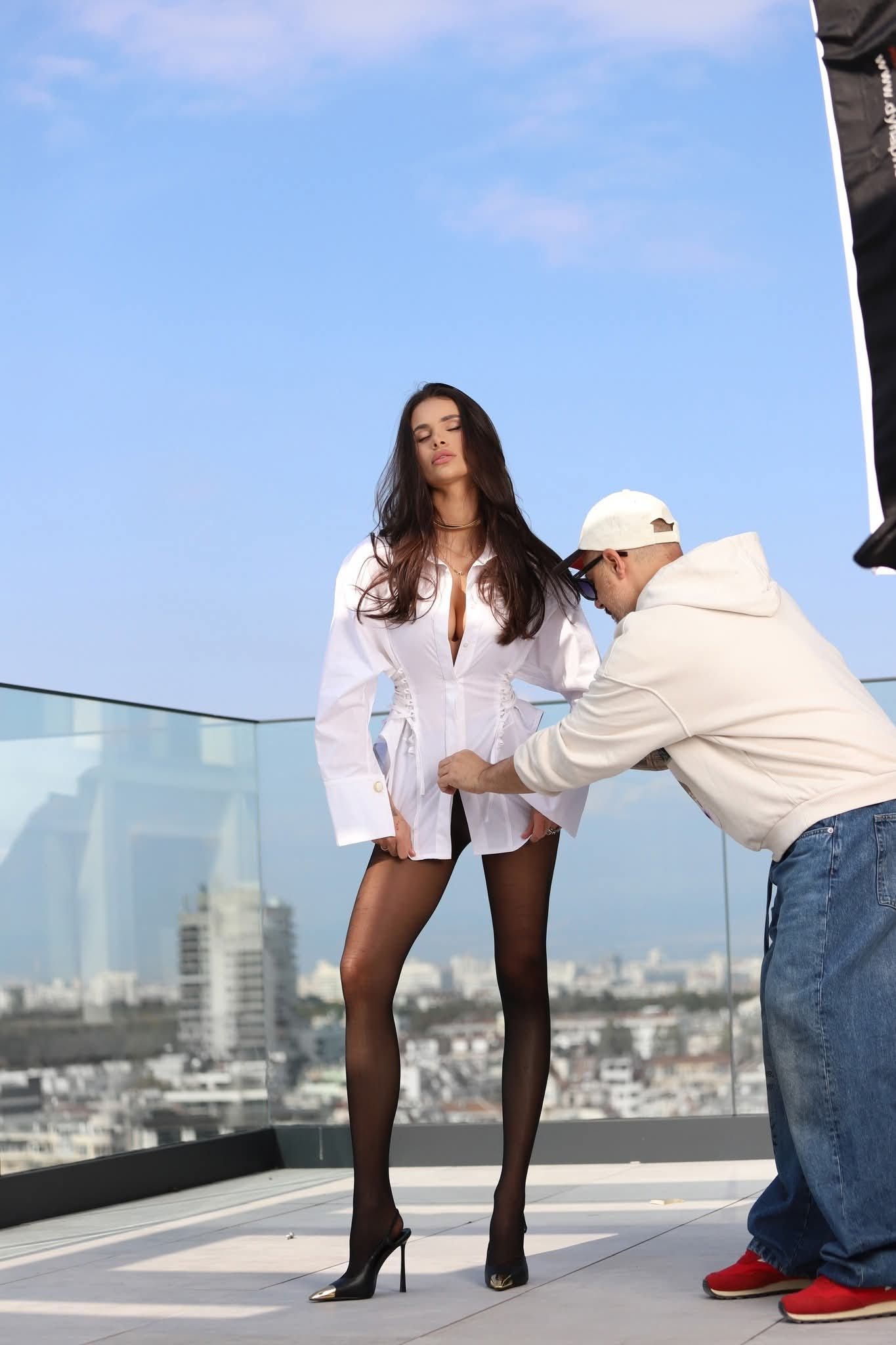
He points me toward the Met Gala as he shares that he is “convinced they feel extremely uncomfortable in what they are wearing,” talking about the smiling, photographed bodies on that carpet. “Nevertheless, the point is the presentation.”
He is careful, though, to say the old rigid arithmetic — the 90-60-90 measurements that once defined what a body had to be to count as fashionable — has loosened globally, even if unevenly. Runways and campaigns increasingly hold space for bodies that would once have been rejected outright, mentioning examples of different ages, ethnicities, and shapes.
“Those old limitations no longer apply in the same way,” he tells me — the same sentence that Bulgarian supermodel Ivelina Choeva reached for when she talked about the industry that hired her precisely for the asymmetry Bulgaria once called ugly. Two people arrive independently at the same observation, that the rules are real, but they are not as fixed as the people inside them once believed.
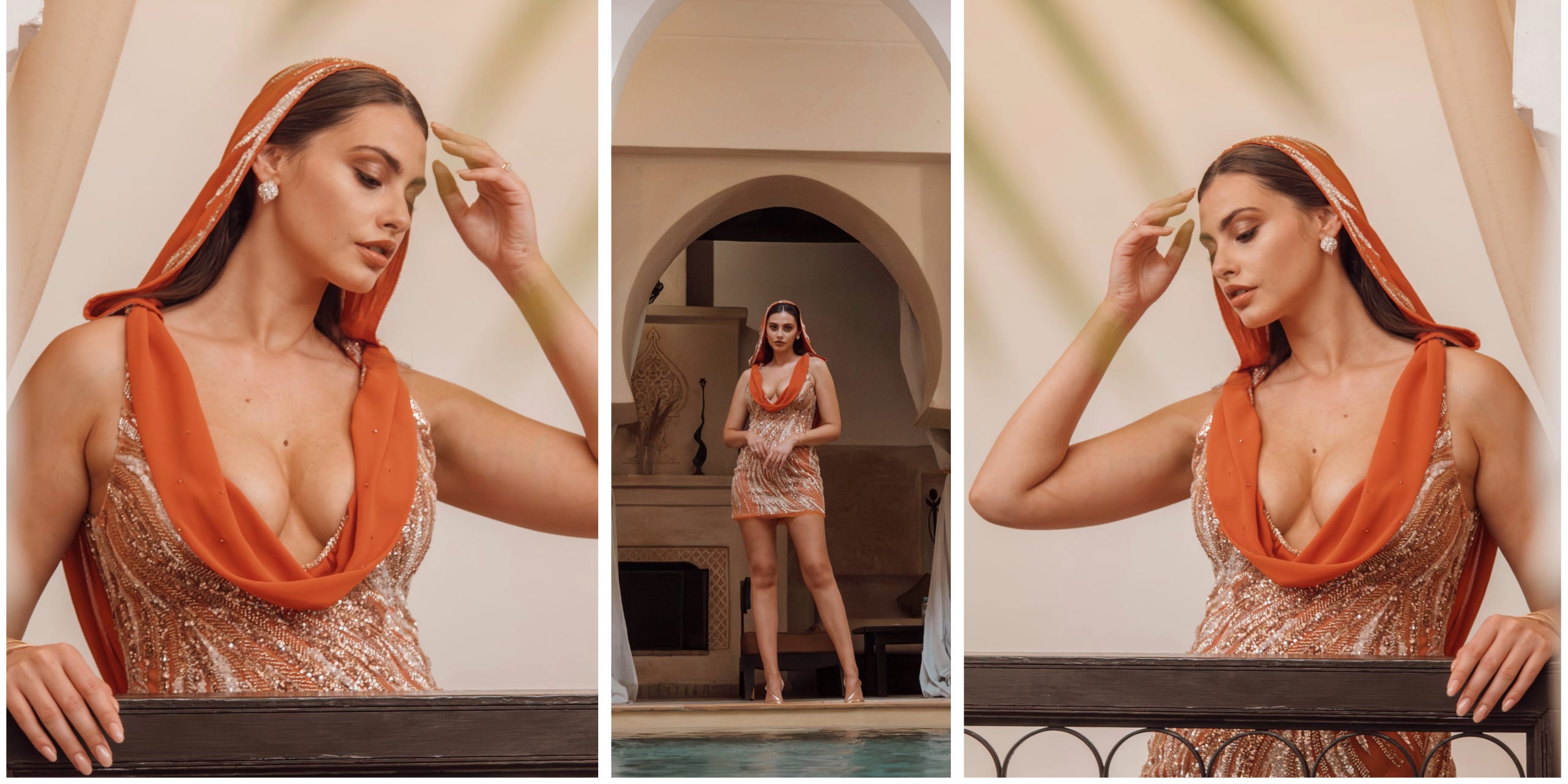
Except — and here his voice changes — the newly-found liberation from standards does not arrive everywhere at the same speed. Eastern Europe, he says without much softening, remains “a slave to idealisation.” Filtered faces, corrected lips, a culture still fluent in the language of what can we fix. He does not exempt Bulgaria from this, and when I mention what I have noticed in Istanbul — the same appetite for sculpted, corrected, idealized bodies — he does not seem surprised. It is a shared inheritance, he suggests, not a coincidence.
The West, he believes, is drifting back toward the natural and the authentically imperfect. Eastern Europe, according to what he has observed, is still catching up — sometimes five years behind, sometimes more. Whether or not the timeline is exactly right, the diagnosis he makes is that “appearance matters to us far more than substance. We sell ourselves more through appearance than through knowledge.”
This is the part of the conversation Stoyan has clearly thought about before I ever asked. Social media, he tells me, has simply replaced the literal garment as the thing that shapes how a body — or a life — gets seen. “It is the foundation of the corset,” he says.
“From that point, the colour is added.” Everything else — the caption, the angle, the story we tell about ourselves online — is just detail laid over a structure we have already agreed to wear.
What is striking me is how little judgment he brings to this, because he does not frame the impulse to curate as vanity or dishonesty. Instead, he says that it seems closer to an old habit fashion has always understood, but is now practised by everyone instead of a professional few: “Anyone can create a different image of themselves and invent a story in order to conceal the truth.”
He does, however, draw one distinction that matters — the difference between how someone sees us and how we have chosen to present ourselves to be seen. The first is out of our hands. The second — the corset itself — is a decision, made and remade daily, about which version of the truth to put forward. “How they choose to see us after that is their decision,” he says, almost releasing the audience from responsibility for a costume he acknowledges he built himself.
There is a version of Stoyan that has nothing to do with a brand, a Met Gala, or a corset trending under someone else’s feed. It shows up when he paints — and when I ask about it, something in his voice shifts. “Perhaps I am saying it in this way for the first time,” he tells me, and then admits that he paints mostly in difficult states — heavy ones, the kind that do not always announce themselves as sad until he is already halfway through the canvas.
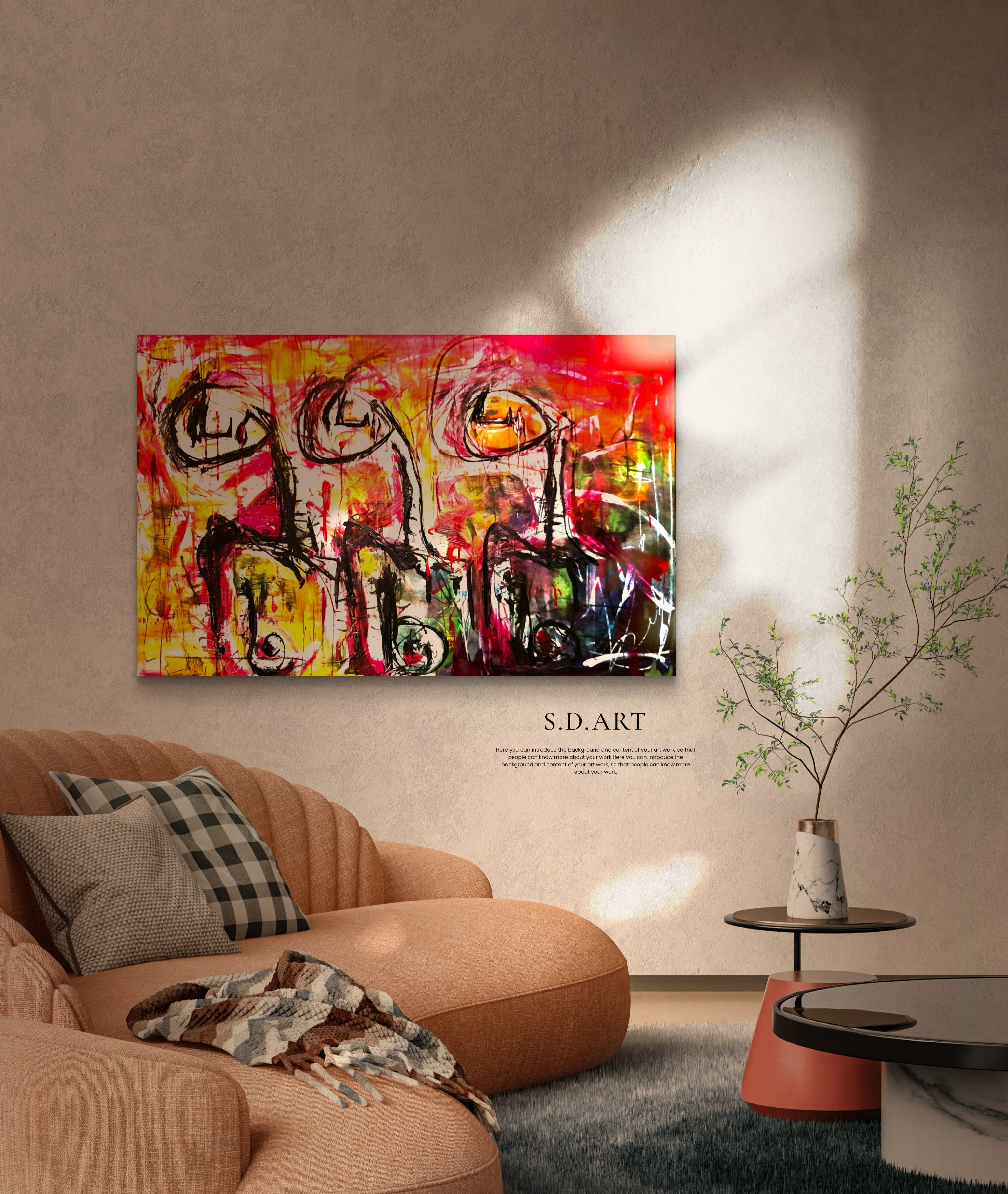
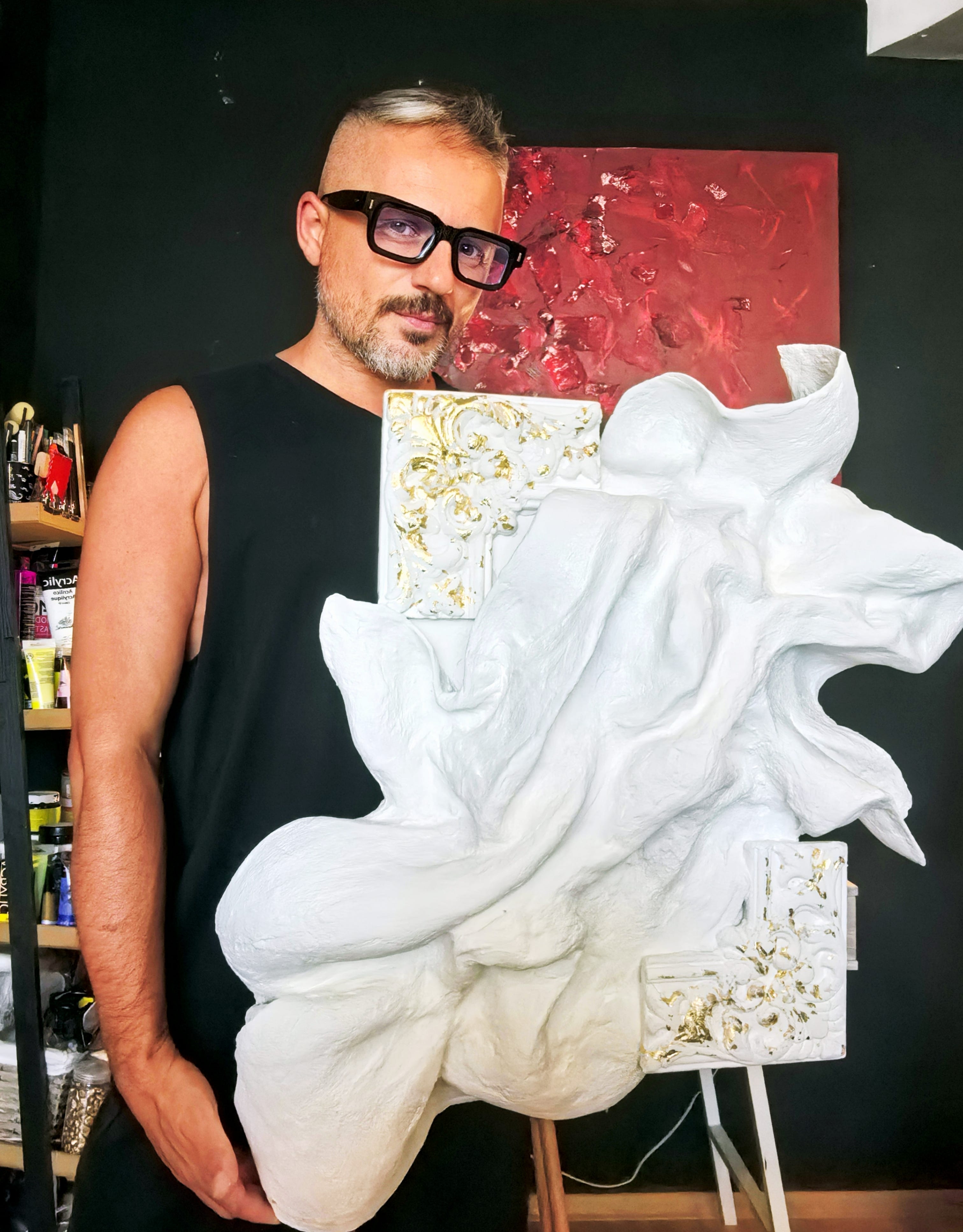
Behind him, out of frame for most of our conversation, hangs The Three Graces — three women caught in a pose he describes as unnatural, tense, and deliberately uncomfortable. He wanted the viewer to feel what the bodies on the canvas feel. He never finishes a painting all the way, he says he leaves it just short of resolved, because resolution would mean the emotion had nowhere left to go. And he almost never paints a full face. An eye. Part of a mouth. A suggestion of a person, never the whole of one. “That is why my paintings often contain an eye or part of a face, but never the complete face. There is mystery in it.”
It is a private, inverted version of everything the corset conversation was about. Online, in fashion, in front of a camera, he has spent a career helping people build the structure that lets them be seen the way they choose. On canvas, alone, he does the opposite as he studies someone until he understands what is underneath their own presentation, and paints that.
Which brings the conversation, inevitably, back to where it started — to the line he offered before I had asked anything at all. “When you undress as a person and show yourself as you are, you are left naked.” The corset comes off. What is underneath was always there, waiting on the other side of the shaping. “If the people before whom you have undressed accept you as you are,” he says, “then you do not need that corset. It was unnecessary to create such an image of yourself.”
It is a generous theory of exposure — that the risk of being seen without the structure is outweighed by what is on the other side of it, if you are brave enough, or simply tired enough, to take the corset off in front of the right people.