

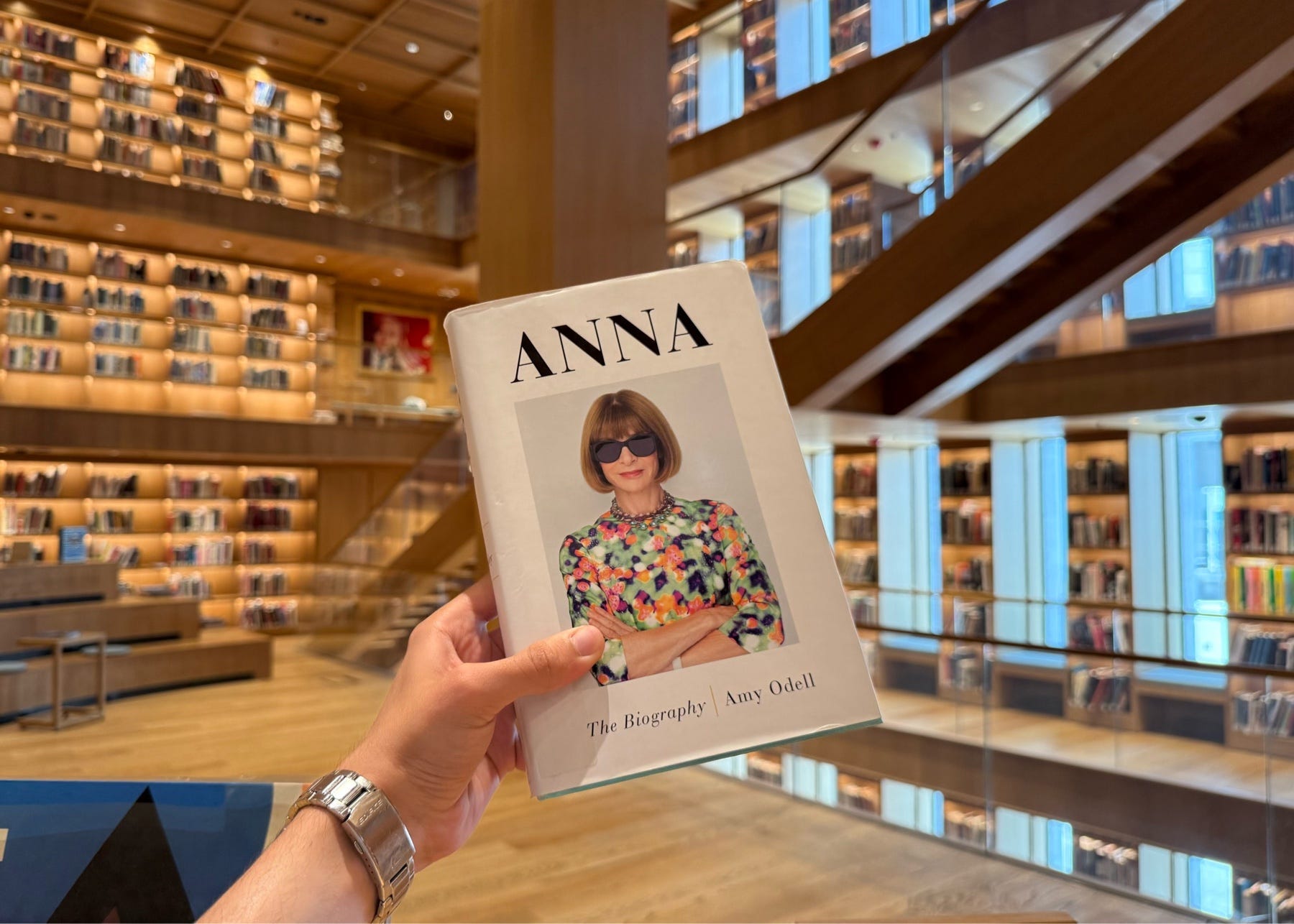
I spent years waiting for a different life, and then I accidentally started building one through repeated mornings.
It began, as most changes do, on an ordinary day a month ago. I woke up, spent some time staring at the little multicolored blocks on Google Calendar — chaos and hell lurking inside them while only pretending to be marking my teaching slots — dreaded the day ahead, ate breakfast, and came to my office.
I am kidding, I do not have an office.
What I have is a place that marked the beginning of my reinvention and homecoming to my true self — the media person eager to craft beautiful pieces about culture, music, art…
That version of myself was not always so difficult to locate. At nineteen, he was working as a reporter and video podcast host at one of the biggest media companies in Bulgaria. He was curious, ambitious, hungry for culture, and aware that his future belonged somewhere inside media, interviews, music, art, fashion, and the strange electric glamour of public life that he had already grown used to.
Then life happened. Or, more precisely, Istanbul happened. Love happened. Breakups. Rent. Teaching, because I couldn’t work as a journalist in Istanbul.
And that self, I buried accidentally somewhere between my first breakup and my permanent relocation to Istanbul. And thanks to the very practical obligation of paying for an adult life and the chaos of day-to-day survival, my weeks became filled with teaching English, more teaching, detesting teaching, wanting to escape teaching, and preaching how I wanted to return to television, return to writing, and, most importantly, return to myself.
Somewhere in this havoc, I would write personal essays, each of which became my ‘comeback’ to writing.
A comeback only until I went to bed past two in the morning again and woke up around noon to begin teaching again, or a comeback until I would get distracted by the next foreigner in Istanbul and disappear into his temporary orbit. A comeback until I found my next actual partner, got engaged at twenty-three, and then watched that imagined future collapse in a plot twist so vulgar and operatic that it deserved its own press release — which it got.
Unfortunately, my days last year were full of chaos, for which I blamed myself relentlessly.
Recently, I have started to wonder whether chaos felt so familiar because, for a while, I was mistaking it for freedom.
I had recently come out as a gay man and had moved to Istanbul. I was living alone, working constantly, falling in love recklessly, trying to survive financially, emotionally, and creatively. I felt frivolous, and that version of me accepted that maybe, just maybe, freedom meant chaos. Maybe it was supposed to look like late nights, cigarette smoke, missed mornings, beautiful strangers, overbooked calendars, and writing at the edge of exhaustion.
What I was not giving myself was space.
The space to just “tune out and tune in” — a line I had recently returned to while working on my Christina Aguilera quote piece — process what had happened to me, accept that teaching is temporarily funding my next chapter and start executing from where I was.
But unconsciously, chaos was still finding me, or perhaps it was actually me still finding chaos.
That day a month ago, after having had breakfast, I entered my office — the Atatürk Cultural Centre, one of the most marvellous places I have encountered. I ordered my usual hot chocolate with coffee at the café, then went inside the library, which in its purest essence is an excellent example of craftsmanship, with its wooden interiors, ceiling-high shelves and windows, and a remarkable collection of books on fashion, art, cinema, design, and culture.
I sat at my usual desk, opened my laptop, and stumbled upon the racing thoughts in my mind about how I could return to my actual identity.
I remarked on the fact that I was already doing way better than in March, considering I had started therapy in February. I was also back to writing consistently, but I was still craving more output, because I really do not associate myself with being a teacher. All that “could-a, would-a, should-a” you have just read regarding the year that had passed had also planted a seed of mistrust inside me, so I did not fully trust that what I was building was consistent.
The night before, I had watched The Devil Wears Prada 2, known as TDWP2 in Vogue, for the second time, so I was still feeling the lingering influence of its immaculate fashion-world energy, its sense of power and precision, and the impeccable performances of the actors.
Miranda Priestly’s spirit was still around me, and knowing her mythology has long been linked to Anna Wintour, I decided to explore Anna’s life more closely.
I opened the library catalogue on my laptop and searched for Vogue, hoping I would find some archival issues here. Instead, among the top results, there she was — Anna Wintour, smiling behind her iconic glasses.
It read “Anna”. Simply “Anna”.
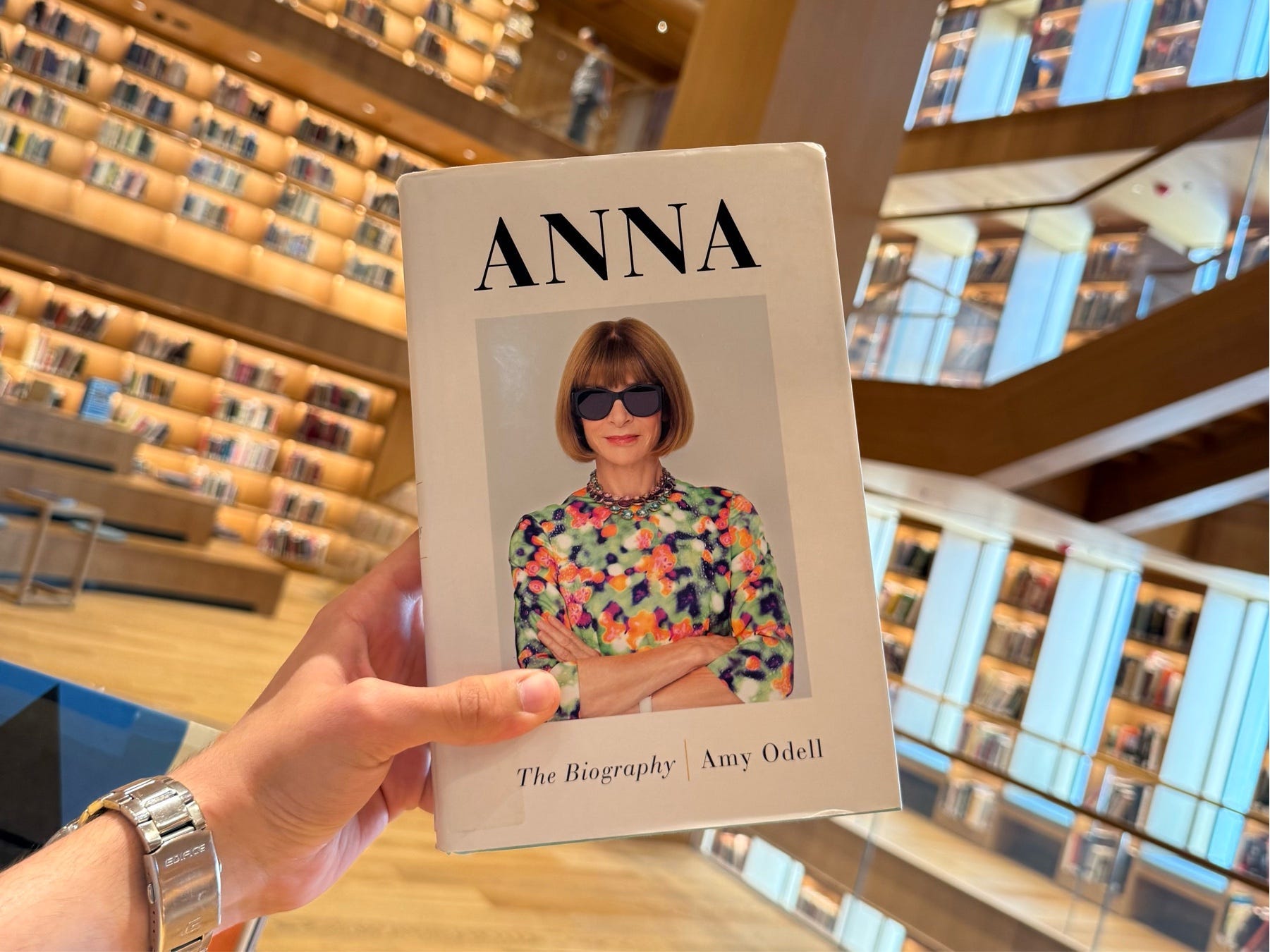
That was it, I had found her biography, written by Amy Odell.
I took a photo of the call number and took a stroll around the shelves and floors to look for “Anna”. I found her sitting on a shelf on the third floor, I reached for her, and with the excitement of someone who had just discovered a key, I started reading the introduction.
“Of course she was wearing the sunglasses.”
I began reading the description of what happens to be the day following Donald Trump’s first election as president, and the reactions it had caused within Vogue’s ranks and the all-staff meeting that followed.
What got my attention, however, was:
“Anna started the day as usual. She rose by 5:00 a.m., exercised at 5:30 or 6:00 (depending on whether she played her twice weekly tennis or worked out with her trainer), sat for thirty minutes for professional hair and makeup, and was then chauffered to her office at 1 World Trade Center, where her three assistants and her usual breakfast — a whole-milk latte and a blueberry muffin from Starbucks, which would mostly go uneaten — were waiting for her.”
I was thrilled and immediately thought to myself: “‘Rose by 5:00 a.m.’ What a tempting thought”. I read a few more paragraphs, left the book on the shelf again with the promise to continue reading it every day, and returned to my seat.
I already knew that Kris Jenner, for example, wakes up at 4:30 a.m. every day and that waking up early is a habit that many successful people have. But still under the spell of TDWP2 and Miranda Priestly, somehow the idea really was tempting, and I started thinking about whether I could apply this routine to my life, too.
Maybe it was also because Anna Wintour made the idea feel less like productivity and more like authorship. I could sense that the reason behind her waking up so early isn’t just because “successful people wake up early”, but because she might like psychological control over the day. Mornings are quieter. She avoids reactive chaos. So I decided to try it out the following morning.
When my alarm rang at 5:00, I stood up, not fighting against it, but actually feeling the quiet pride of having achieved a small victory against the version of myself who always negotiated with the alarm.
I did yoga, which had already become part of my routine. I had breakfast. I got ready. Then I walked to the cultural centre, ordered my hot chocolate with coffee, waited for the library to open, and returned to the third floor, where Anna was sitting on the shelf.
Reading her biography became one of my morning rituals.
Around the same time, I subscribed to Vogue. That, too, became part of the ritual: hot chocolate with coffee, Vogue before the library, then Anna, then the work of the day.
It sounds small because most rituals do. That is their power.
My therapist has taught me a lot about structure recently. Not structure as punishment or the enemy of creativity, but structure as the environment that makes change possible.
It appears that if we look at change as a wave, then structure is the shore.
Motivation is a feeling. Discipline is a decision.
But structure is the habitat that makes decision-making and discipline simpler. Structure is built by rituals and habits, and it helps you take the next step. It reduces the number of negotiations and removes the drama from beginning all over again.
And the reason why rituals are key to building long-lasting structure is that rituals are signals to the nervous system saying: this is where we start, this is how we continue, this is where we return when everything else becomes too loud.
Examples of my rituals: the morning drink; the same table; the book on the third floor; the Vogue article before work; the notebook; the opening of the day before the day opens its mouth.
Rituals are small ceremonies of self-trust and repeated gestures through which you tell yourself:
I am choosing myself, I am coming back again. I am not waiting for inspiration to rescue me from disorder. I am in control.
Now I wake up at 5:00 a.m. every day. I do yoga, aim to arrive at the cultural centre by 7:45, have my hot chocolate with coffee, study Turkish, read Vogue, read Anna, and then begin the tasks of the day.
And something has shifted.
Flawlessness is impossible, of course, the structure sometimes still breaks in the evenings. I still get tired. I still have teaching slots. I still occasionally feel the gravitational pull of old chaos. But there is now a backbone where there used to be longing.
I am feeling better than ever, I am writing and publishing, because now ideas are constantly coming to my mind, and I actually execute them. I have set up a content calendar and I am already filling July. I am beginning to feel, with surprising calmness, that I will not be teaching forever, because I finally built a structure that allows another life to become possible.
Most importantly, thanks to my therapist, Anna Wintour, Miranda Priestly — all three powerful women, three Devils in their own way — I realized that there’s beauty, almost frightening beauty, in a life run with precision, clarity, image, standards, and ritual.
And there is the quiet realization that structure itself has not made my life smaller, but more glamorous.
For years, I thought glamour belonged to clothes, labels, cities, hotel lobbies, and expensive cafés. And perhaps, it does, in part. But lately, I have started to see glamour differently — there is power in a life lived with intention, in knowing where your morning begins, in the discipline of protecting your mind before the world starts asking for pieces of it. It is taste, but also timing; standards, but also repetition; beauty, but also boundaries.
Life finally has somewhere to place its dreams.
And maybe, just maybe, inspiration is what appears after you sit at the same table, open the same notebook, and prove to yourself — morning after morning — that you are coming back.
An earlier version of this essay was originally published on I Couldn’t Help But Wonder on Medium. This version is now part of The Wonder Mag archive.